01The brief
The owner's words, verbatim:
"The main reference should be cyberpunk edge runners for aesthetic and vibe, omega strikes for the 3D models interpretation of the art. We want our volley ball player roster to have abilities in the future. We intend to connect that to the lore of the game. Cybernetic parts, highcontrast, neon aesthitic. Gadgets, hybrid humans etc will be the visual explanation of our abilities. I want some strong references from the anime Hikuy! We have already built the animations a lot on the anime. Bodymodification references should be Ghost in the cell and Akira anime. The final feel should not be a full blast anime but a mix of modern USA desighn and strong anime painted details in the 3d models."
02Five pillars
Every asset, screen and effect must serve at least one pillar. When two pillars disagree, the higher one wins.
Readable at 106 px
The game camera shows a player about 106 px tall. Silhouette, team colour and the one ability part must read at that size, in greyscale.Volleyball drama
The hit is the hero moment: the apex of the jump, the contact frame, the impact ring. From Haikyu!!.Neon night city
Dark colour-blocked spaces, hard neon rim light, wet reflections. From Edgerunners.Cyber explains power
Each ability has one visible body part, shape and glow colour. From Ghost in the Shell and Akira.US sports structure
Team systems, bold condensed numbers, broadcast graphics, sneaker culture. Anime detail lives inside that frame.03Reference board
What we take and what we leave from each reference. The images below are the owner's own screenshots (local study only, never shipped). Facts are marked P published or I inferred; the research digest names its sources.
Cyberpunk: Edgerunners (Trigger, 2022)
- PNight City is "a mix of today's Los Angeles and big Chinese cities or Tokyo": already the US-plus-Asia mix we want.
- IColour has jobs: yellow is the loudest signal, magenta is danger and glitch, cyan is HUD.
- IShadows: one or two hard steps, tinted violet or blue, never grey. Neon is a coloured side rim light.
- ICyberware: a hard seam where plate meets skin, glow in thin lines, one signature implant per character.
Do: hard colour-block backgrounds, a coloured rim light, one signature implant.
Don't: soft bloom on every surface; all three neons in one small area.
Omega Strikers (Odyssey Interactive)
- PEarlier study (
outputs/character-01/style-os/research/report.md): hand-painted, unlit diffuse textures; about 13,600 triangles on a published model; big heads. - IThe 2D illustration survives in 3D because the highlight and shadow shapes are painted into the texture and the geometry stays simple.
- IIdentity: silhouette plus one prop or accent colour per character.
Do: flat painted shapes, one accent per character, big simple silhouettes.
Don't: realistic fabric; thin props that vanish at 106 px; their big-head proportions (the owner rejected the "young kids" look).
Haikyu!! (Production I.G)
- PThe films built every cut as a 3D layout first, with a library of attack and block poses, then drew the characters over it. Our Lab already works this way: gameplay layout first, clips on top.
- IBorrow: the low-angle spike from behind the blocker's hands, the held apex, the held contact frame with a hard shock ring, a bright floor in a dark gym.
- IKits: one team colour, one trim colour, a large number.
Do: hold the contact frame; a low camera at the apex.
Don't: speed lines on every action; more than two kit colours.
Ghost in the Shell (1995, SAC) and Akira (1988)
- PGITS lit its scenes from light sources, not from contrast; its thermo-optic camouflage was a distortion of one illustration over the background.
- PAkira used 327 colours, about 50 new, mixed for glow: bright orange against dark blacks and blues.
- ITetsuo's arm is the "organic growth plus machine" reference for one rare, huge signature limb.
- IAt game size: one seam line, one colour change skin to plate, chrome as a painted highlight on a dark base, 2 or 3 thick cables at most.
Do: a visible seam and a skin-to-plate break; dark base with bright accents.
Don't: full chrome bodies; many thin cables; dark metal against a dark outline.
Modern US sports and streetwear
- PHi-Fi Rush's art lead: "what if a Japanese artist was asked to animate an American comic book", so it "doesn't feel like a Japanese anime, but it doesn't feel completely like an American made game". This is our target feel, one step toward sports.
- ITeam branding systems, broadcast lower-thirds with a diagonal cut, a big condensed number, sneaker colour stories.
- IGames that mix it well: Hi-Fi Rush (ink line, halftone), Bomb Rush Cyberfunk (graffiti identity), Rocket League (two team colours that never fail).
Do: a bold condensed number with a diagonal cut; team colours that contrast with the wood floor.
Don't: clone licensed lettering; team colours close to the court colour.
Also from the owner
04Proposed looks
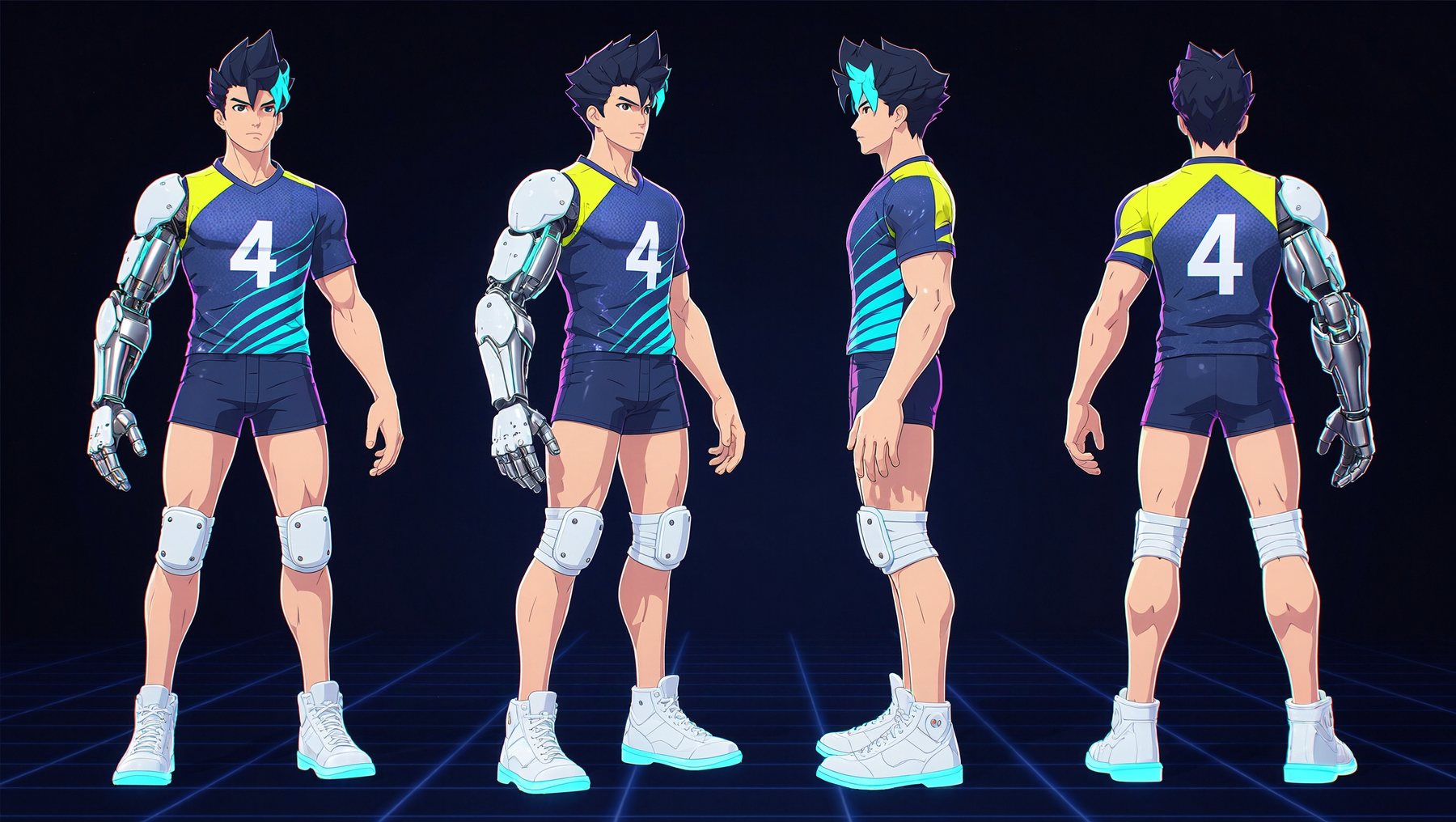
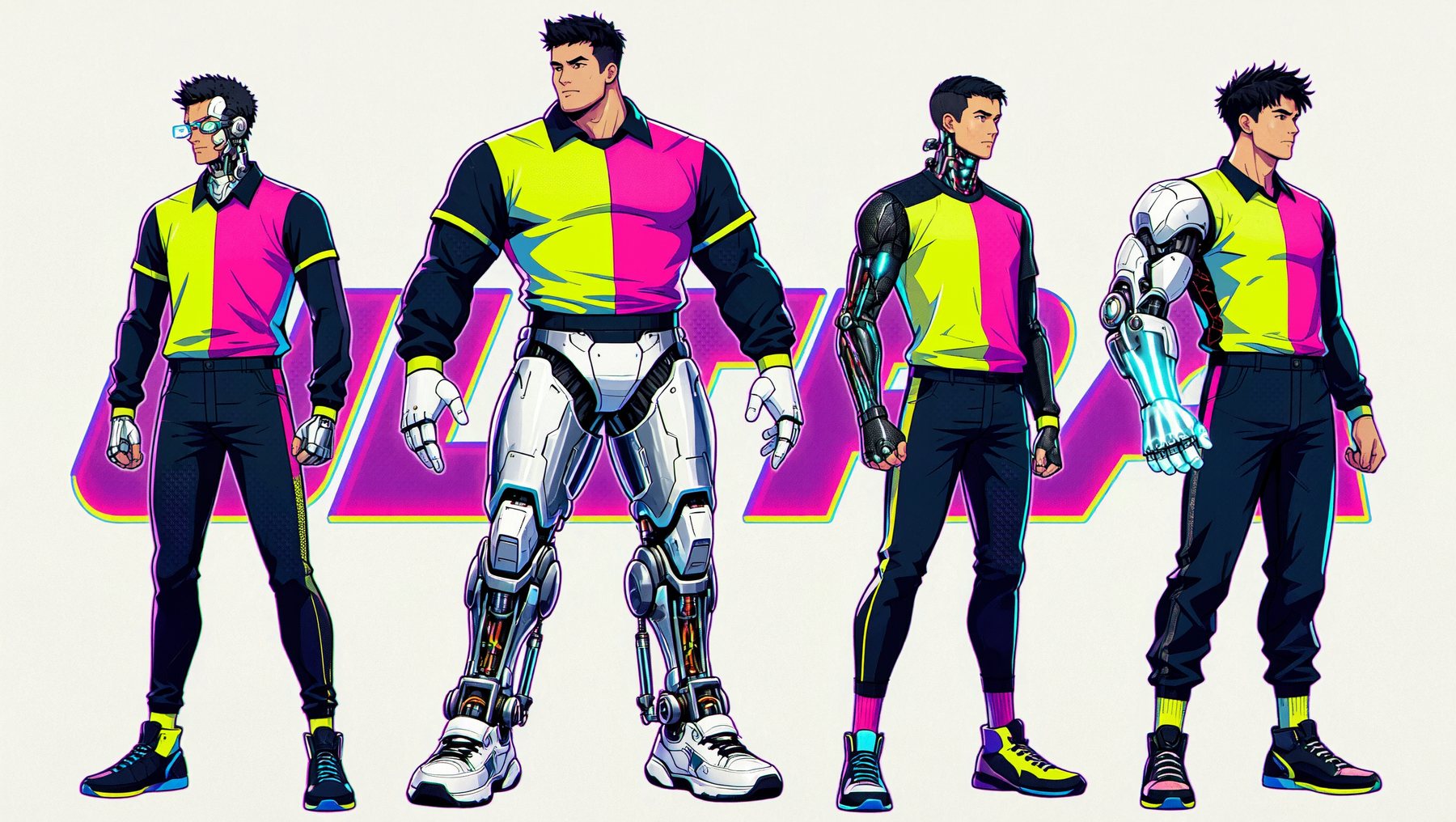
One look from each image model, chosen by the orchestrator. Same prompts for both models
(outputs/visual-identity/prompts.md): the 3D model turnaround, the key art and the roster.
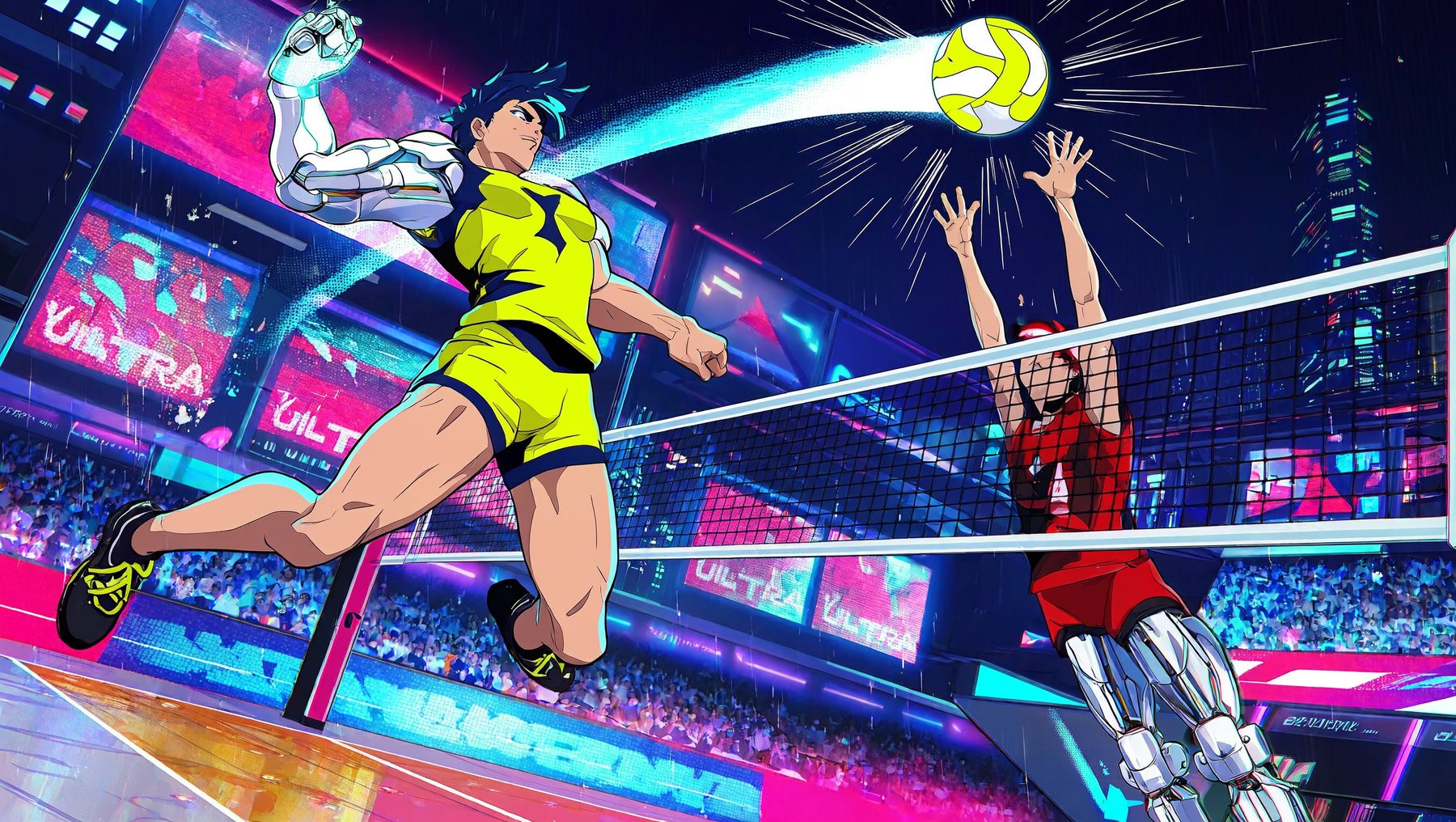
Pending. Antigravity's image quota is used up for about 7 days (HTTP 429). The Blender MCP route needs Blender open with an updated add-on; the Studio route needs a Gemini API key. The same three prompts run as soon as one route is ready.
05Palette
Ten colours with fixed jobs. Team colours own the jersey; ability colours own the cyber parts; neither crosses over. Hex values are inferred, not measured from the reference works.
Open point: the current game teams are blue and red (Way C and Way D models). Moving to cyan and magenta teams is a choice for the owner; red already reads as "danger" in the Edgerunners colour jobs.
06Typography
All three families are free (SIL Open Font Licence on Google Fonts; check the licence file at download). No clones of licensed lettering.
07Ability visual language
An ability is explained by one cybernetic part, gadget or hybrid trait. Each must differ by shape as well as colour (yellow, green and orange are close for some players). Glows sit on small emissive areas on ink or chrome, never on the jersey.
| Ability | Body part | Glow | Shape | Lore hook (proposal) |
|---|---|---|---|---|
| Spike power | Hitting forearm and hand: gauntlet plate | Volt yellow | Wedge or chevron plate with a split seam, a small piston at the elbow | Ren's "Gale" forearm: a sports-league prosthetic, tuned for one swing |
| Jump | Calves and ankles: spring blade or thruster | Acid green | Vertical vents, an ankle ring | Hydraulic legs, the middle blocker's signature |
| Reflex and dig | Eye or temple visor, a spine line | Signal violet | Round lens, a thin line down the spine | Reflex wiring for the libero; flickers before a dive |
| Set precision | Fingertips and forearm | Bone white-hot | Fine dots and thin lines on the fingers | Setter's calibrated hands; a small holographic monocle |
| Block | Shoulders and forearm plates | Signal orange | Wide planar slab with hexagonal edges | Shield plates that lock at the top of the jump |
The gameplay already has moments to show these glows: the charge bar of the Lob, the Perfect Spike, the reaction shot, the fingertip Feint. A glow can pulse on the part at the press and flash at the contact.
08Classes and origins
A proposal. Every athlete has two labels. The class is the role on the court and decides what the ability does; it follows the real volleyball positions, so the animations built on Haikyu!! still fit. The origin is how the body got its power; it decides the lore and how the modification looks. Ability colours come from section 07. Ability concepts build on moves the game already has (the release Spike, the Perfect Spike, the Feint, the Tip, the charged Lob, the reaction shot, the dive, the Float jump). Stat bars are design intent, not numbers in the game.
Chrome
League-licensed cybernetics, built by sponsors to the ULTRA League spec. Reliable and clean.Look: Ghost in the Shell. Panel seams, white ceramic, chrome, thin glowing lines, a hard break at the skin.
Bio
Street hybrid grafts: grown, not built. Stronger peaks, less control; rare and a little dangerous.Look: Akira. Organic swelling, glow under the skin, veins and tendon ridges, asymmetry. Never gore.
Gear
No body modification: rookies and purists with wearable tech, smart gloves, harnesses and sneakers.Look: modern US sports tech and streetwear. Clean products, logos of our own, hard-light projections.
| Class | Court role | Body zone | Shape | Job |
|---|---|---|---|---|
| Striker | Power attacker · outside hitter | Hitting forearm and shoulder | Wedge plates, a split seam, a piston | Ends the rally. Hardest spikes, the biggest Perfect Spike payoff. |
| Wall | Defensive blocker · middle | Shoulders and forearm plates | Wide planar slabs, hexagonal edges | Owns the net. Bigger block reach, stuffs and soft touches. |
| Skyline | Aerial attacker · opposite | Calves and ankles | Spring blades, vertical vents, an ankle ring | Lives in the air. Highest jump, longest hang, attacks over the block. |
| Playmaker | Precision setter | Fingertips and one eye | Fine dots and thin lines, a holographic monocle | Makes the others better. The set decides the attack. |
| Anchor | Agile defender · libero | Temple visor and spine line | A round lens, one thin line down the back | Keeps the ball alive. Digs, dives and reaction shots. |
| Phantom | Trickster · feints, Tips and Lobs | Arm skin panels | Thermoptic shimmer, no glow colour | Wins with lies. Feints, Tips and placed Lobs that read as something else. |
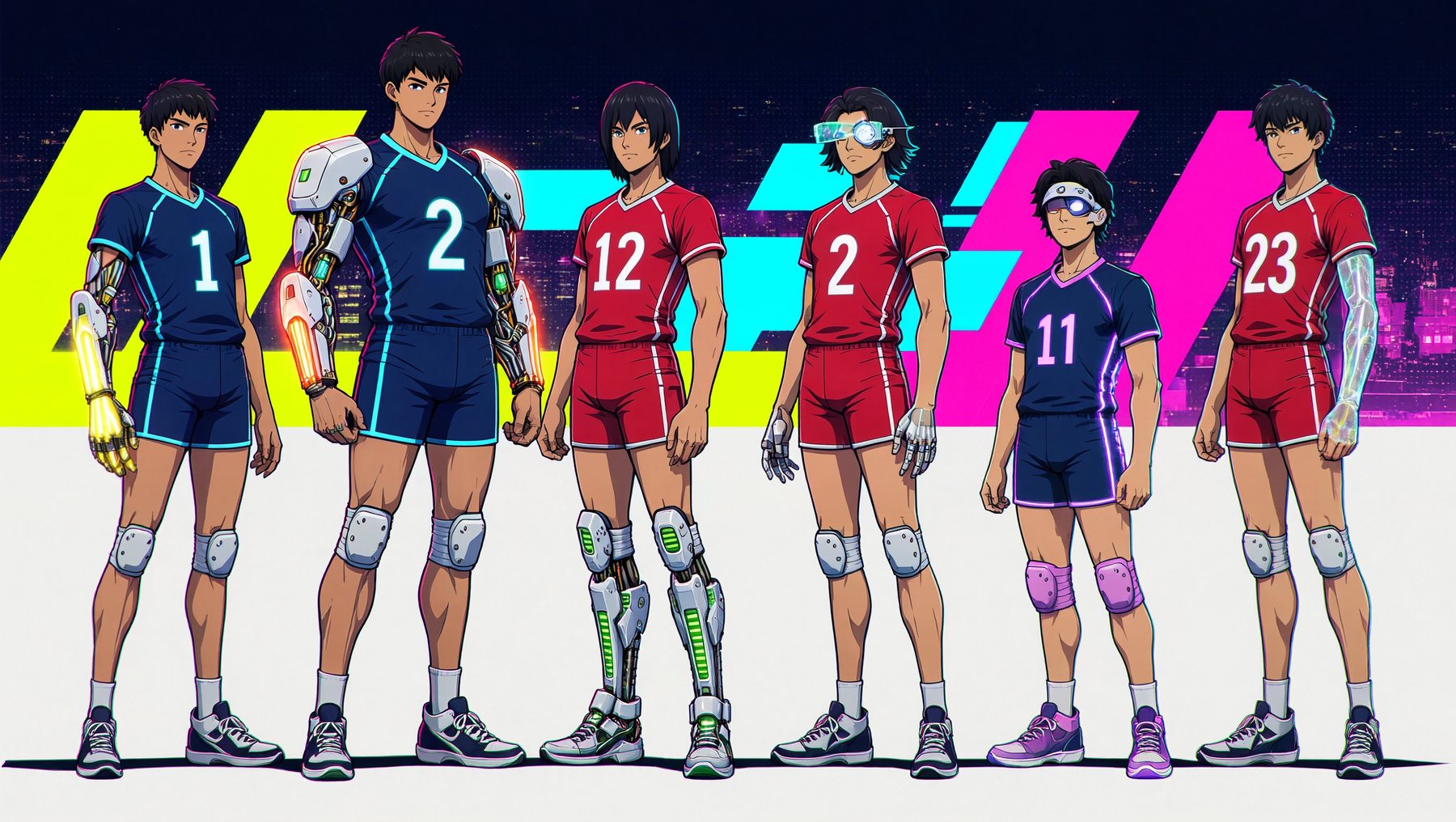
Striker
Ends the rally. Hardest spikes, the biggest Perfect Spike payoff.
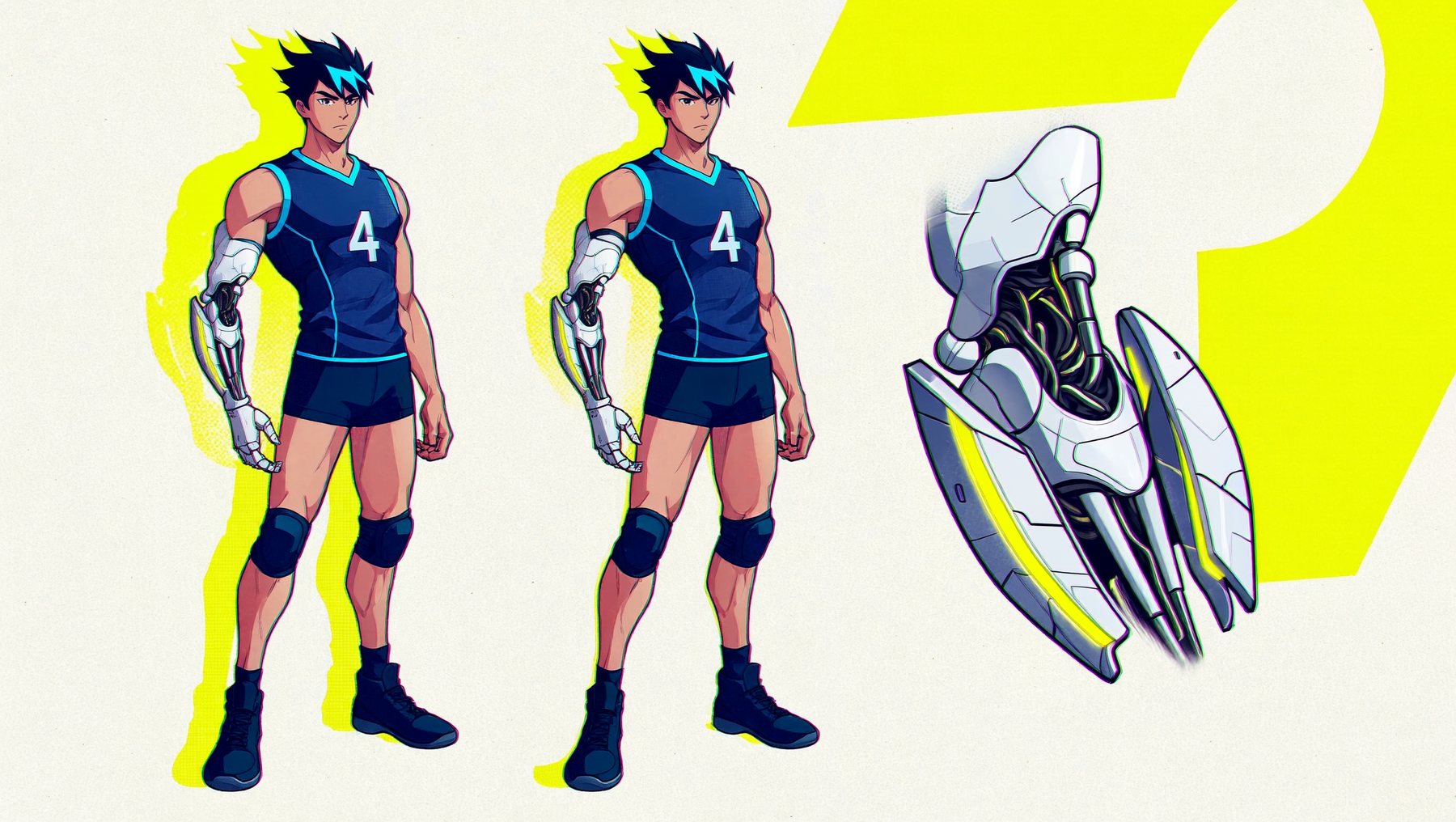
Ren Kazamaki#4
The hero. Lean V-taper, navy-black spiky hair with one cyan lock, deep blue kit with cyan wind lines. A white ceramic and chrome forearm, the "Gale".
Gale Spike. Holding the Spike wind-up longer stores pressure in the forearm; the release hits faster, with a narrower timing window. It builds on the release Spike that the game already has.
The forearm plates split open along a volt seam during the hold, brighter as it charges; one chevron pulse at the contact.
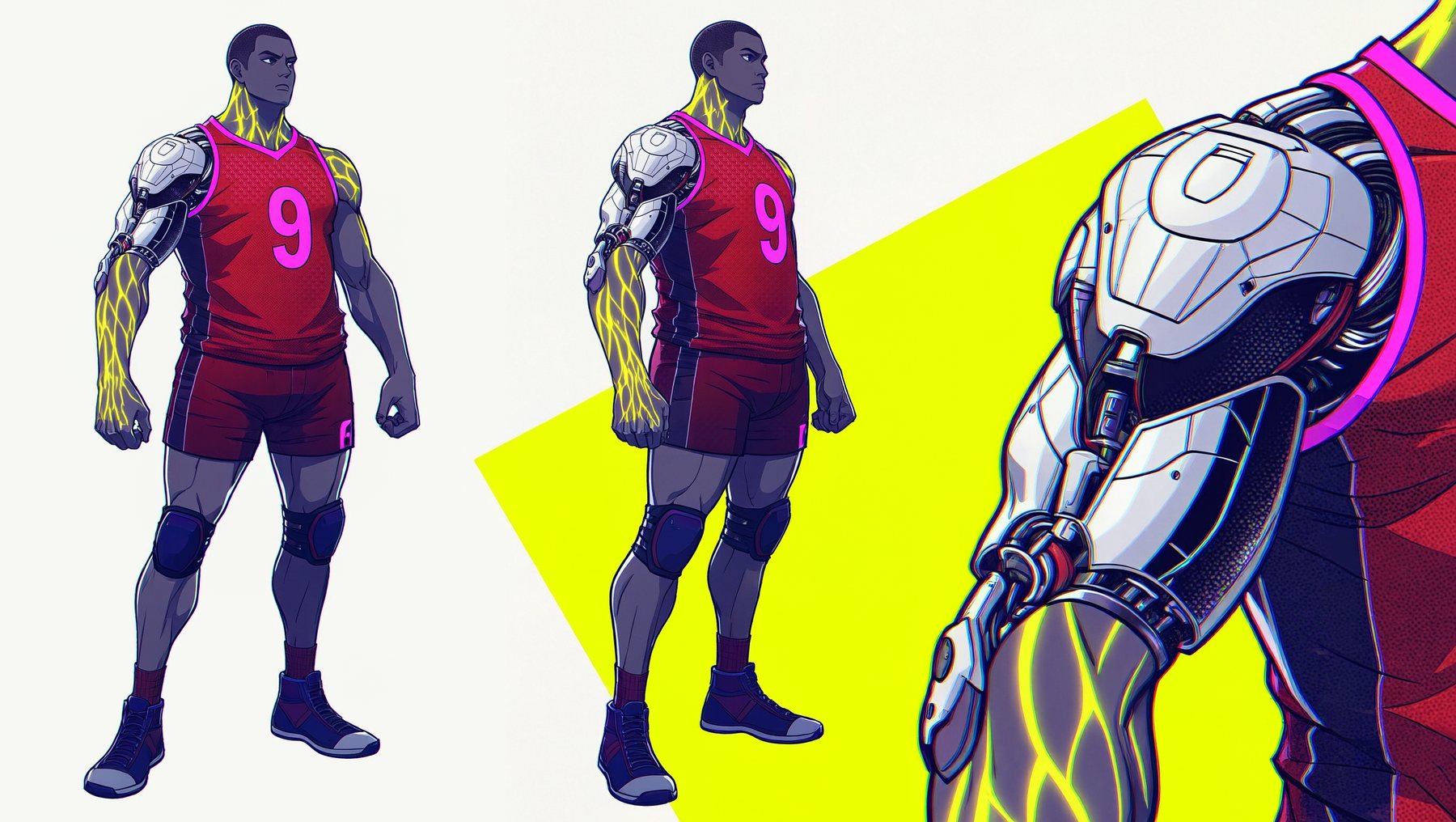
Kade Morrow#9
Broad and heavy, buzz cut, sleeveless jersey. A grafted shoulder of dense fibre bulges under the skin: the Akira reference, organic and a little wrong.
Rupture. Once per set, a spike so heavy that the receiver's pass quality drops one grade, even on a clean dig.
Volt veins glow under the skin from the neck to the wrist; the shoulder swells for one frame at the impact.
Wall
Owns the net. Bigger block reach, stuffs and soft touches.
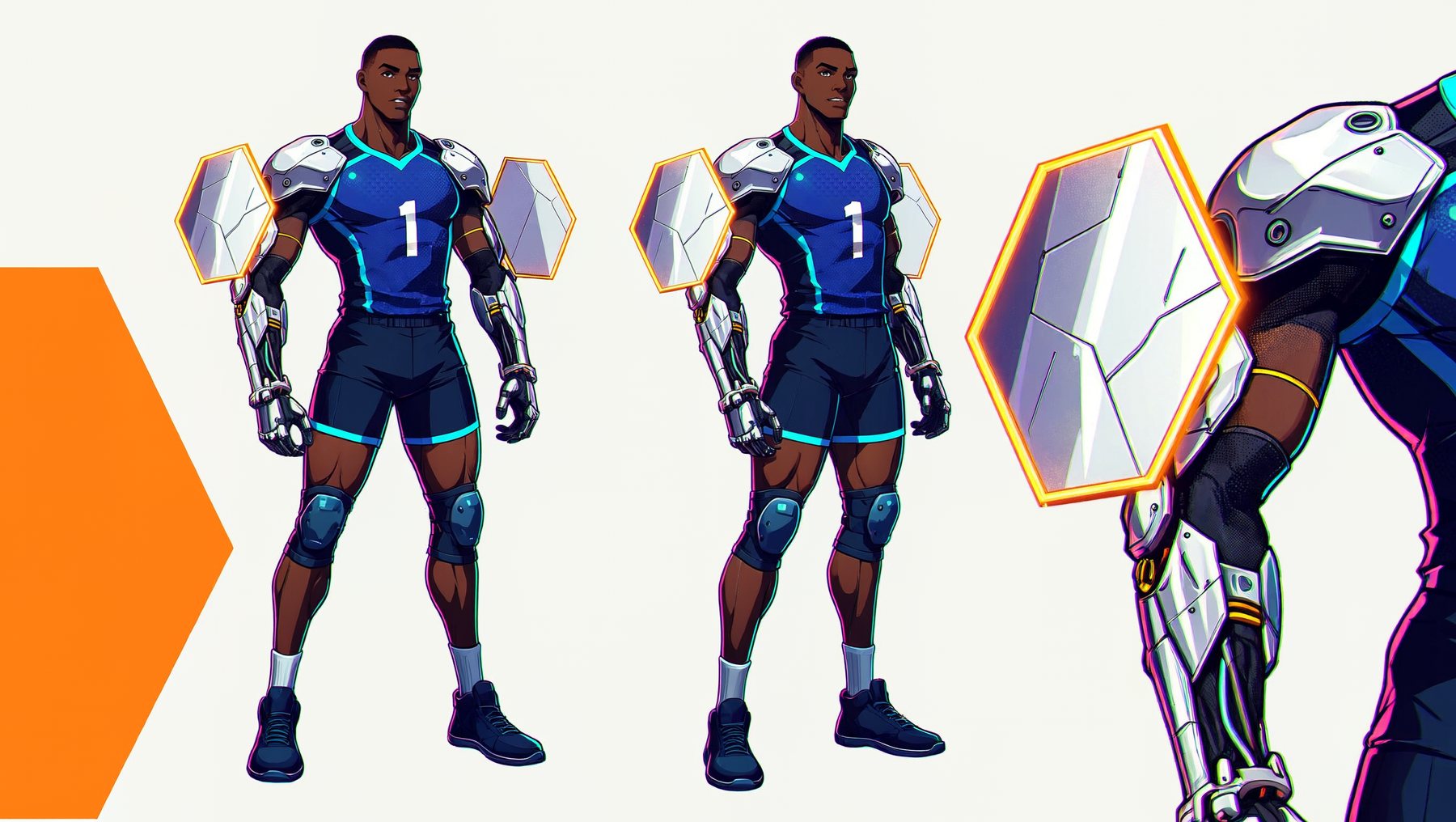
Dax Okoye#1
2.01 m, very broad, shaved head with a side fade. Chrome shoulder slabs bolted over a compression top, forearm plates.
Lockdown. At the top of the block jump the plates lock and widen the block's reach for a few ticks.
The plates snap open into one hexagonal slab with orange edges; a heavy clunk on the lock.
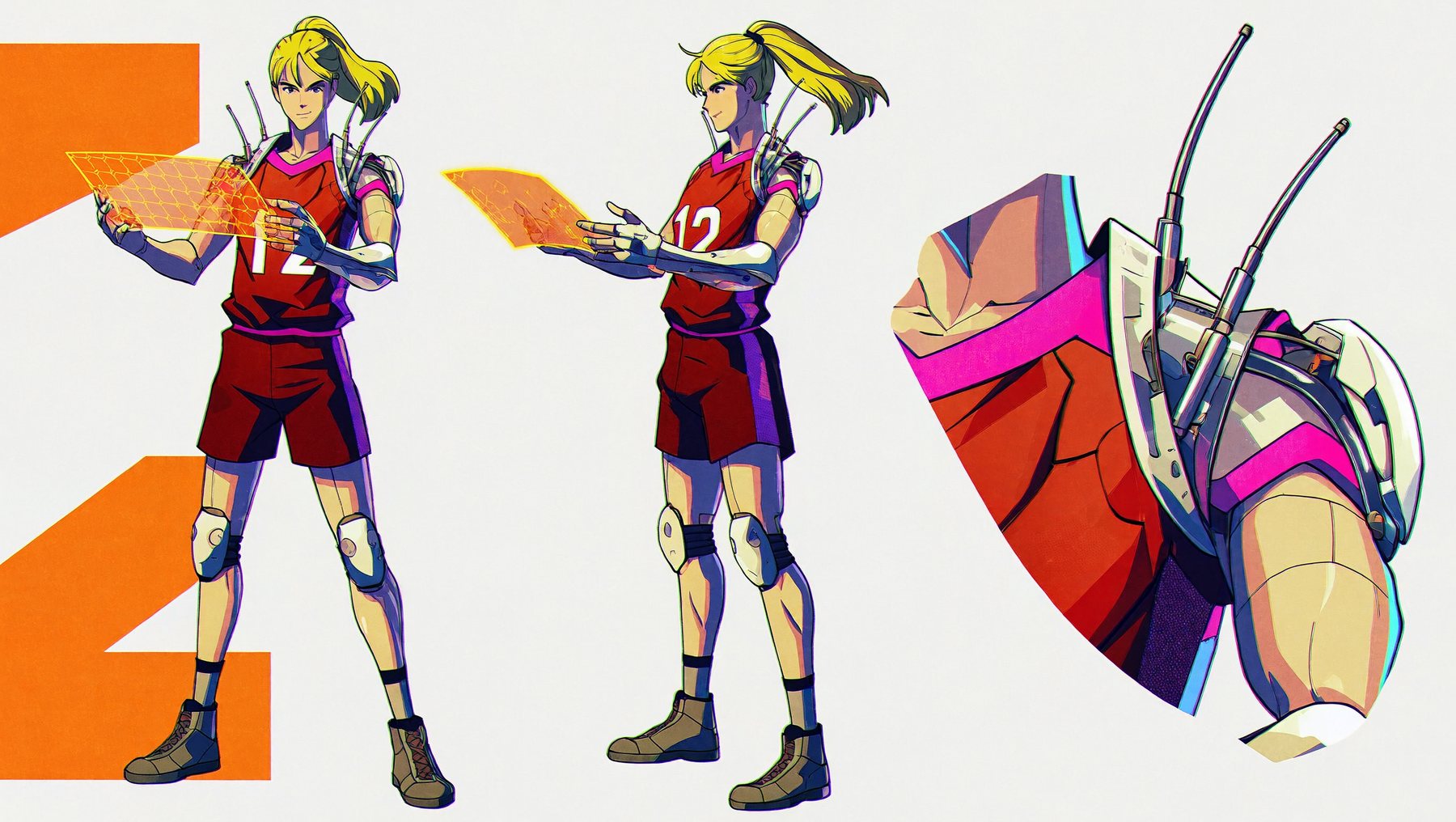
Ivo Strand#12
Tall and lanky, long blond hair in a band. No implants: a slim shoulder harness projects a translucent orange hard-light panel.
Field Wall. A ball that touches his block slows down and drops on his side as an easy free ball.
The harness hums; an orange hex grid flickers between his hands at the touch.
Skyline
Lives in the air. Highest jump, longest hang, attacks over the block.
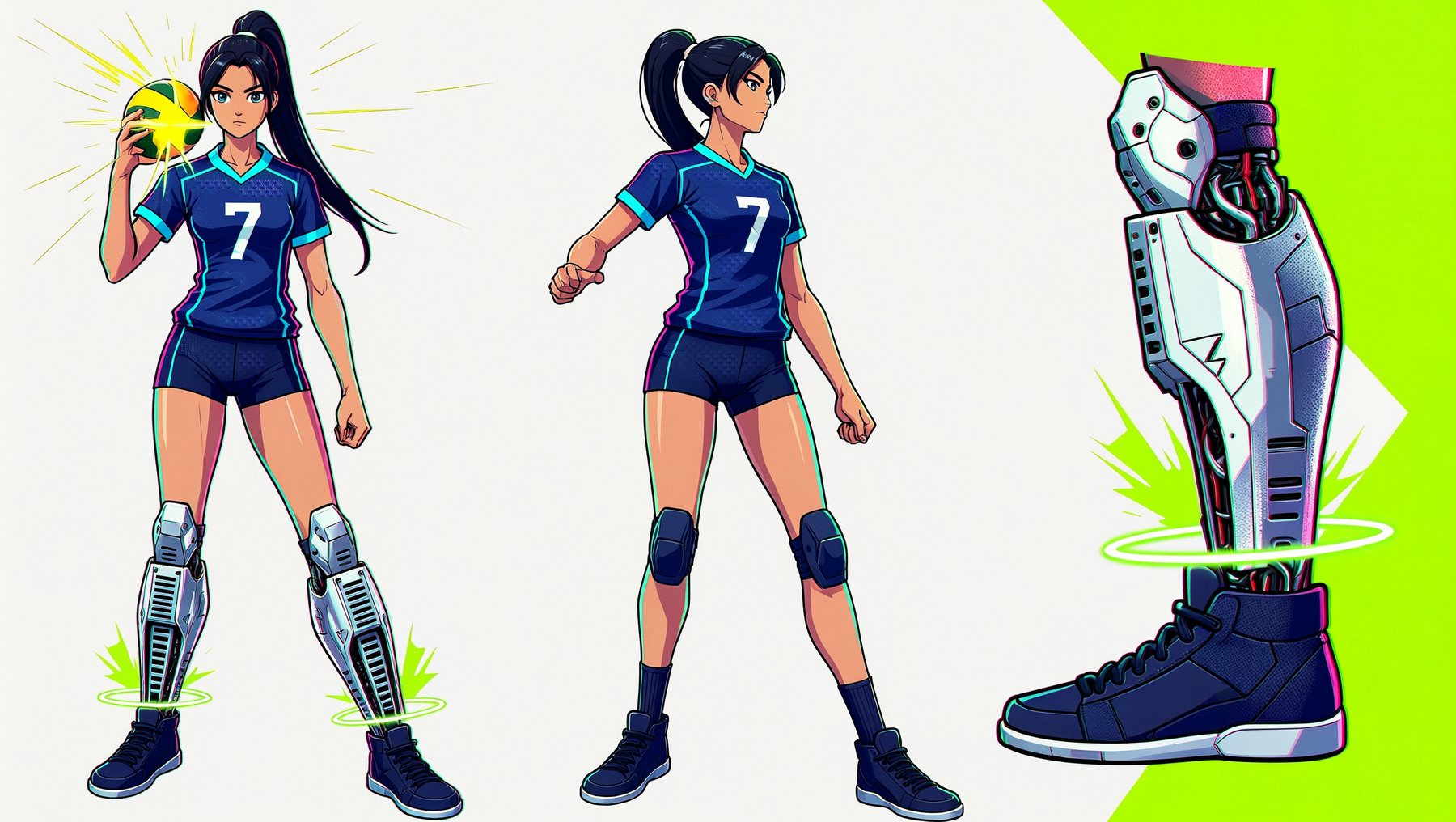
Juno Vasquez#7
Long-legged and light, high ponytail. Chrome spring-blade calves from the knee down; the kit is cut short to show them.
Hang Time. A longer float at the apex: the game's Float jump made into a class trait, more time to choose spike, Tip or Feint.
The ankle vents flare green at the takeoff; a thin green ring hangs at the apex.
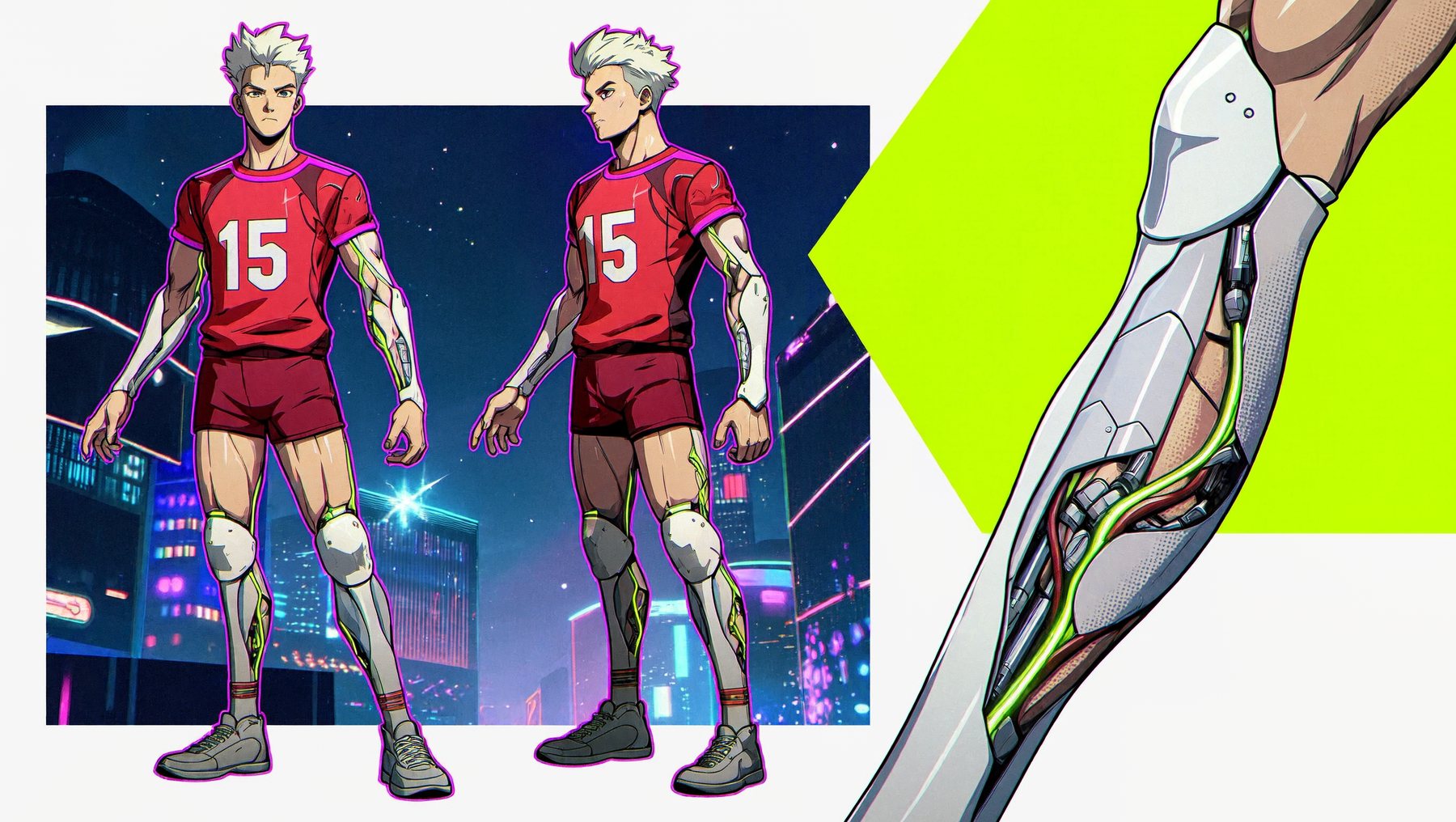
Pell Arata#15
Wiry, bleached spiky hair. Grafted tendons make the calves long and tight, with a ridge under the skin.
Coil. A crouch before the jump stores energy: the longer he waits on the ground, the higher he goes.
Green light lines tighten along the calves during the crouch; a burst of dust at the release.
Playmaker
Makes the others better. The set decides the attack.
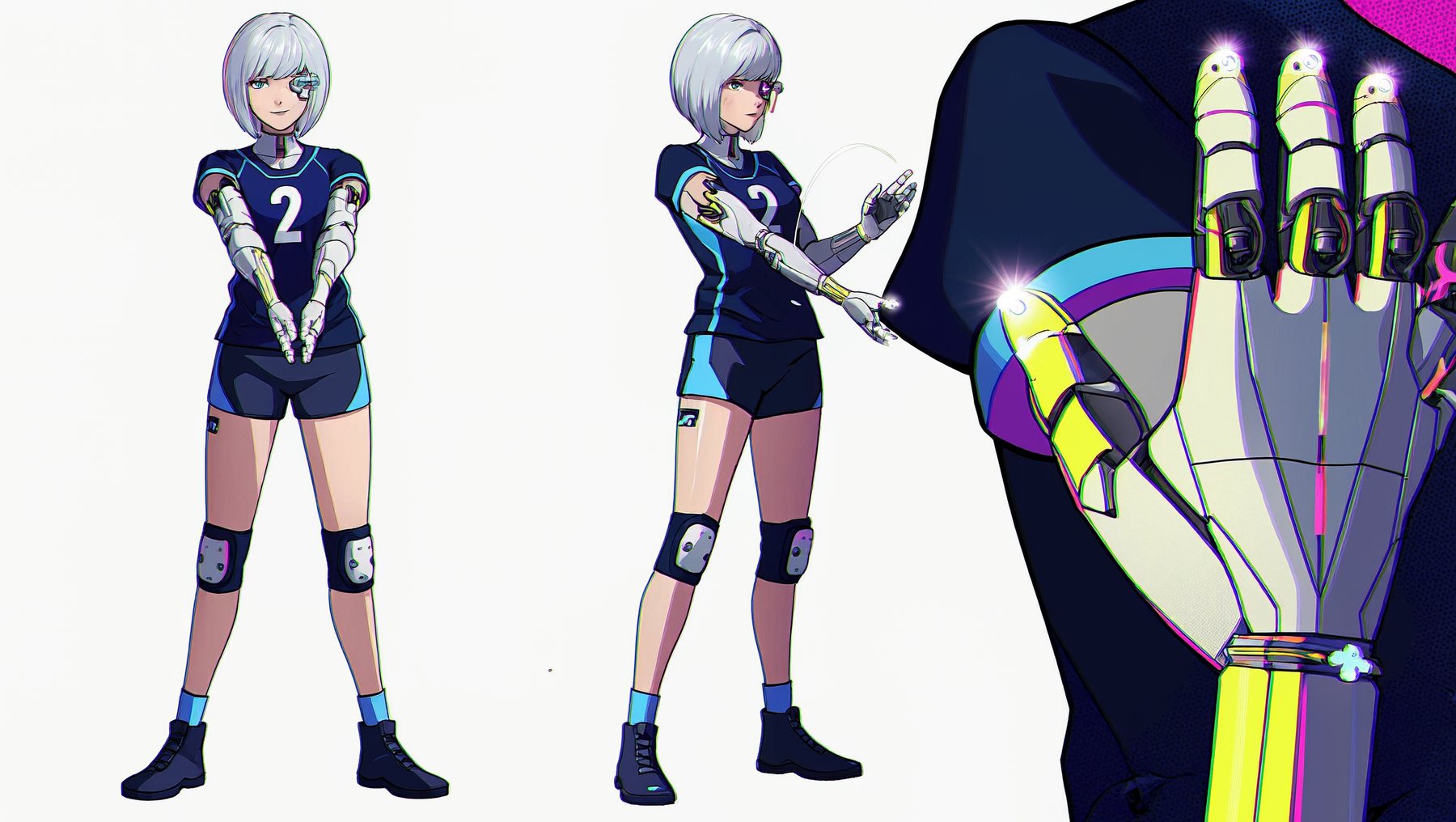
Mika Sorensen#2
Lean and balanced, short silver bob. One cybernetic eye with a small holographic monocle, sensor dots on the fingertips.
Perfect Read. Her set shows the hitter the best contact point and widens the hitter's Perfect timing window.
The finger dots light white before the set; a thin white arc previews the ball's path for the hitter only.
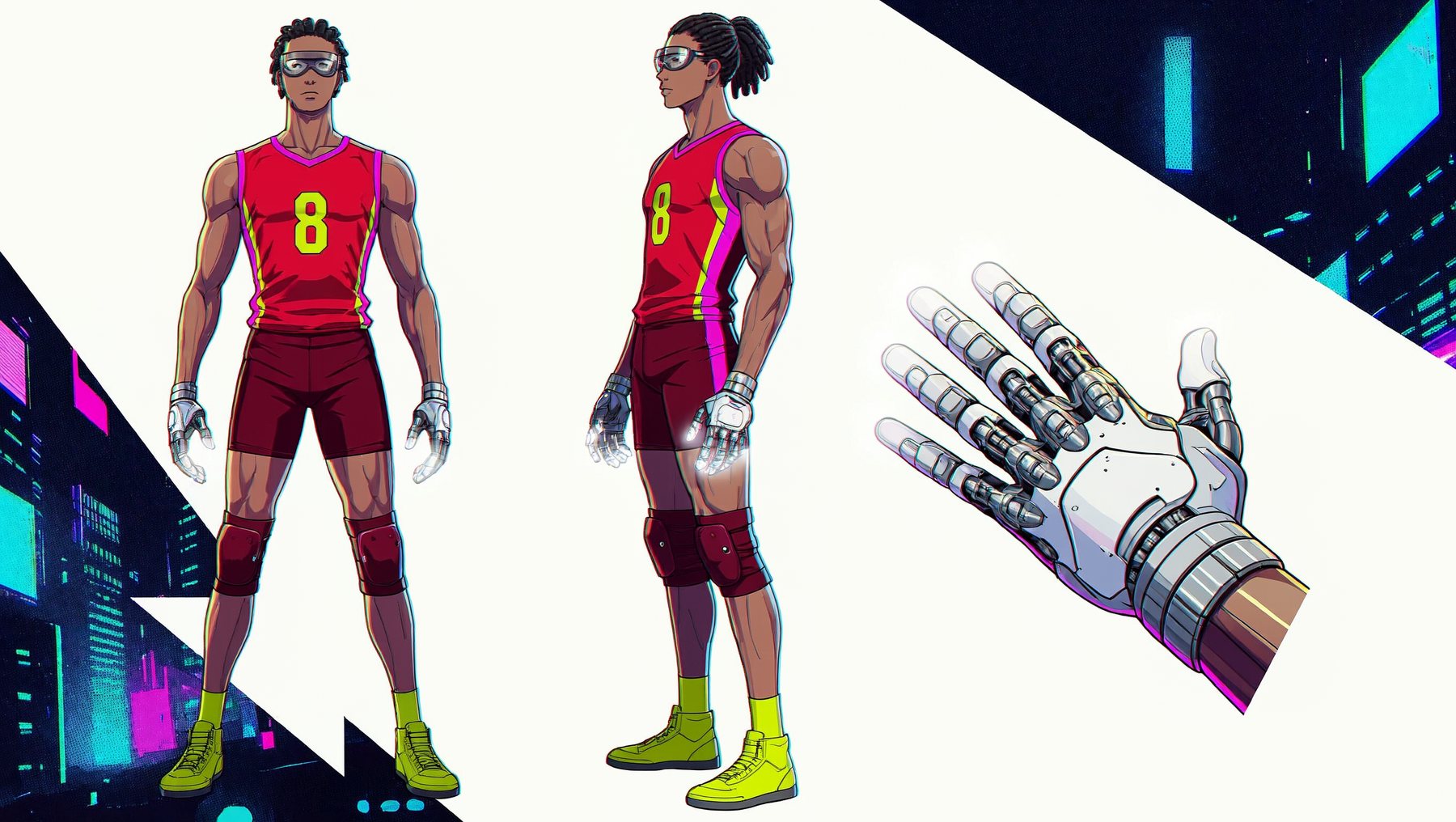
Theo Banks#8
Tall setter, locs tied back. Smart gloves and a clip-on visor, no implants.
Quick Link. A faster, lower set to a chosen teammate: the quick attack.
The glove tips flash; a short white line links him to the chosen teammate for one beat.
Anchor
Keeps the ball alive. Digs, dives and reaction shots.
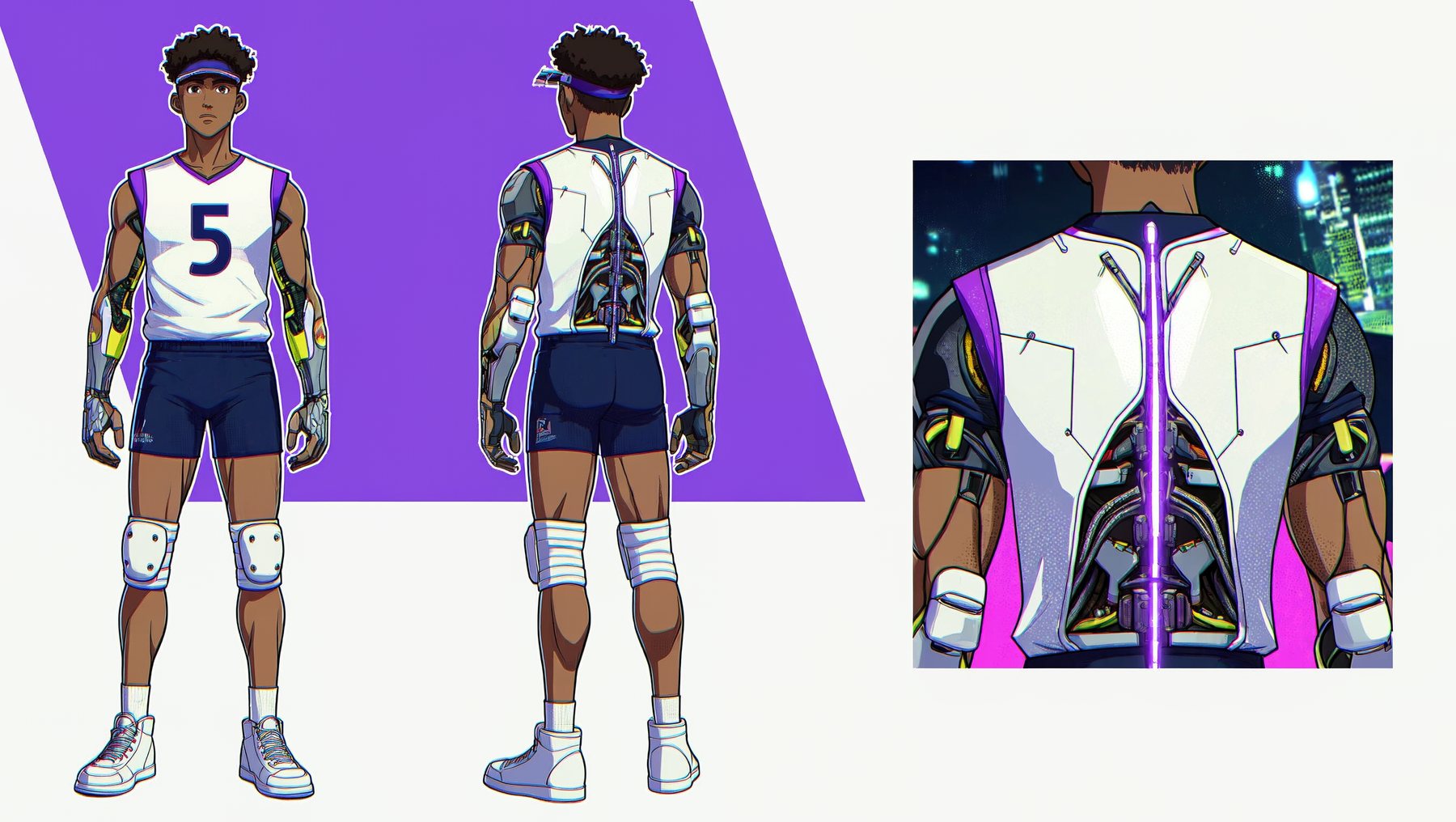
Noa Kealoha#5
Compact and low, curly hair under a headband, a libero kit in a contrasting colour. A thin chrome line down the spine, a temple visor.
Reflex Burst. A short slow-down before a dig or a dive. It builds on the game's dive and reaction shot.
The spine line flickers violet; the visor flashes once at the trigger.
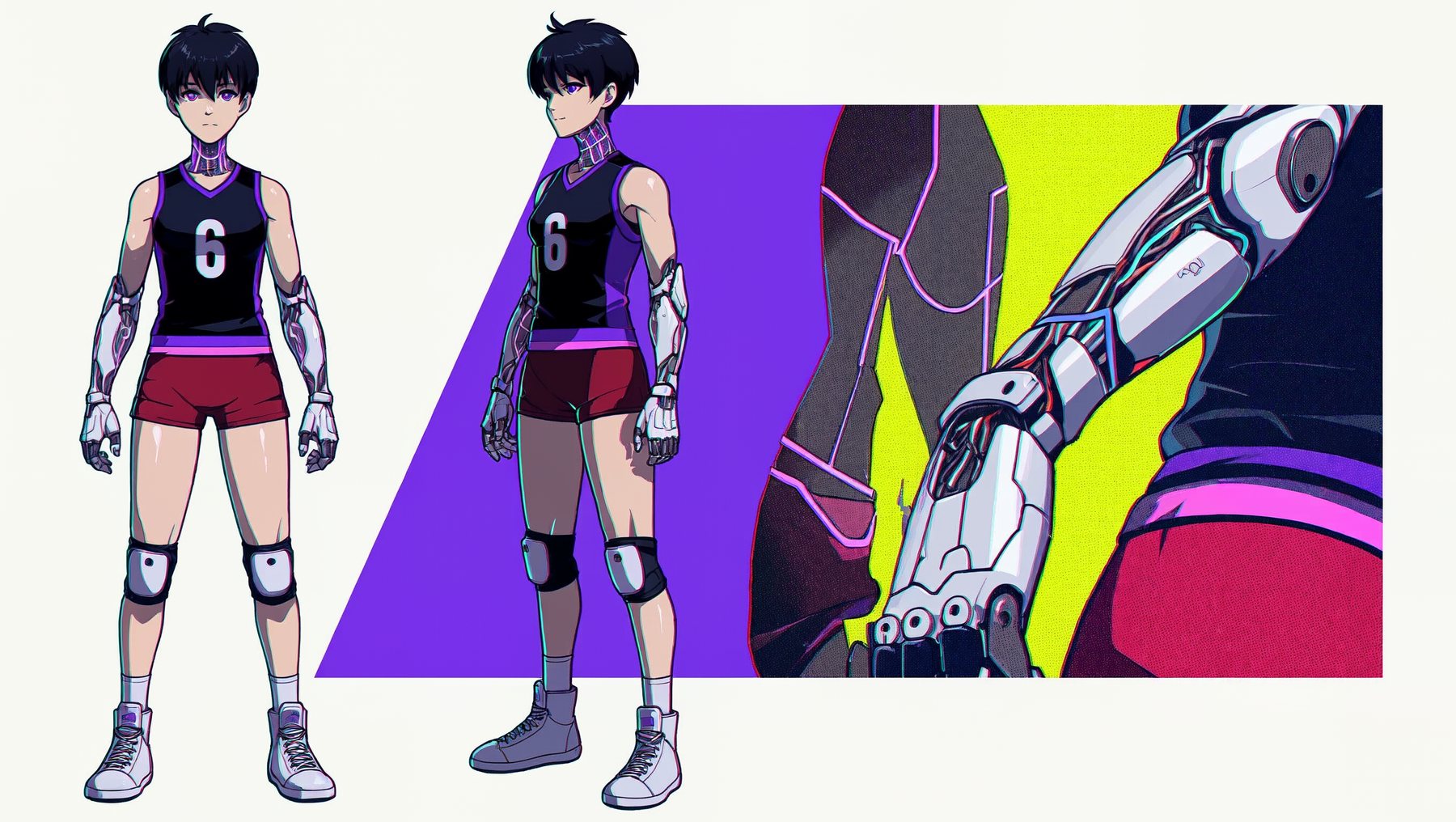
Sable Ito#6
Small and sharp, short black hair. A nerve graft shows as violet lines on the neck and forearms.
Sixth Sense. She sees the landing point of an incoming spike a moment early.
The violet lines pulse when a hit is coming; her eyes glow for one frame.
Phantom
Wins with lies. Feints, Tips and placed Lobs that read as something else.
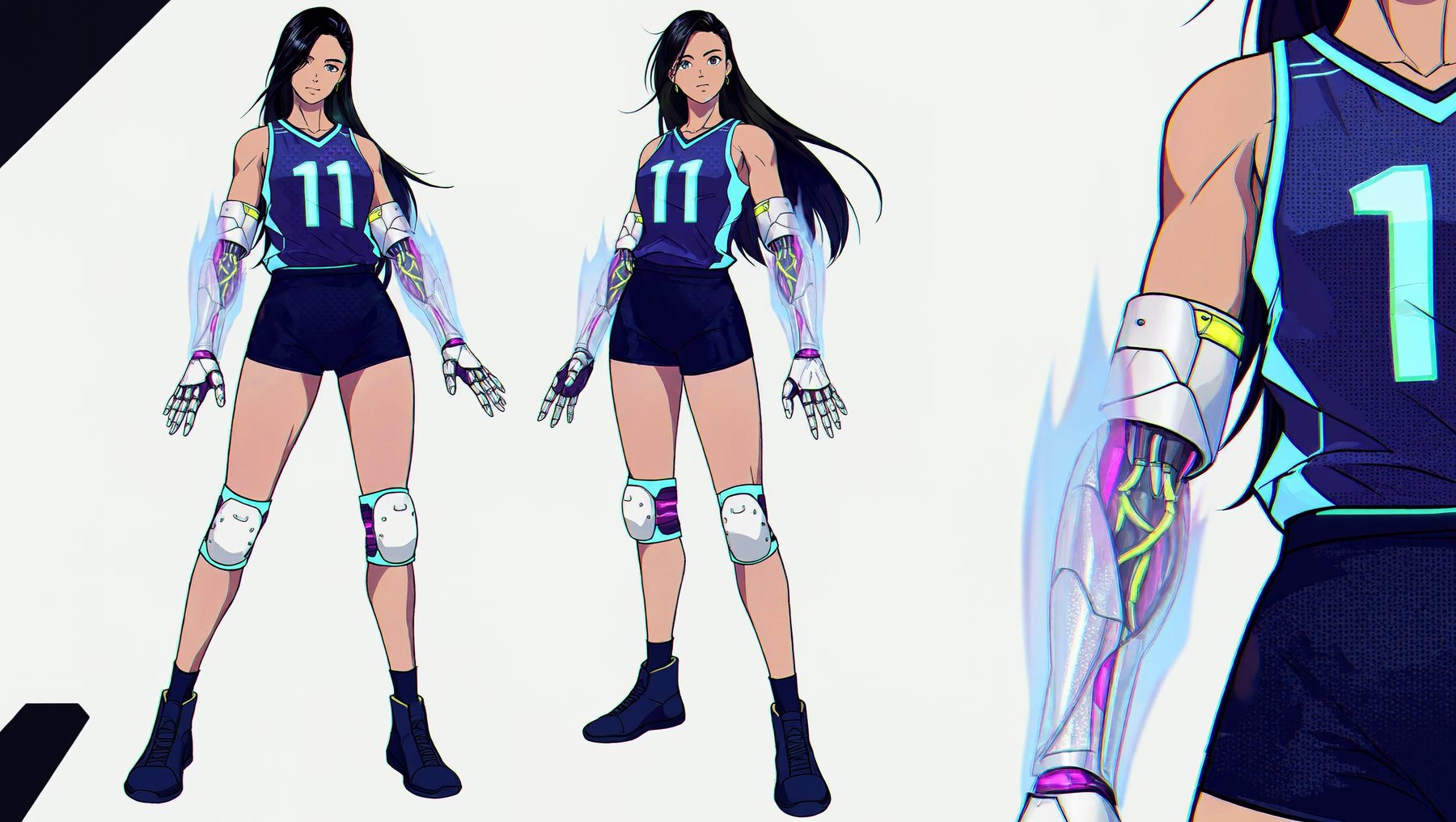
Vesper Hale#11
Slim, long black hair with an undercut. Thermoptic panels on both forearms: the Ghost in the Shell camouflage, used on a sports court.
Ghost Touch. The fingertip Feint leaves an afterimage of a full spike, so the blockers read the wrong move.
A heat-haze shimmer runs along the arm; the outline drops out for two frames at the touch.
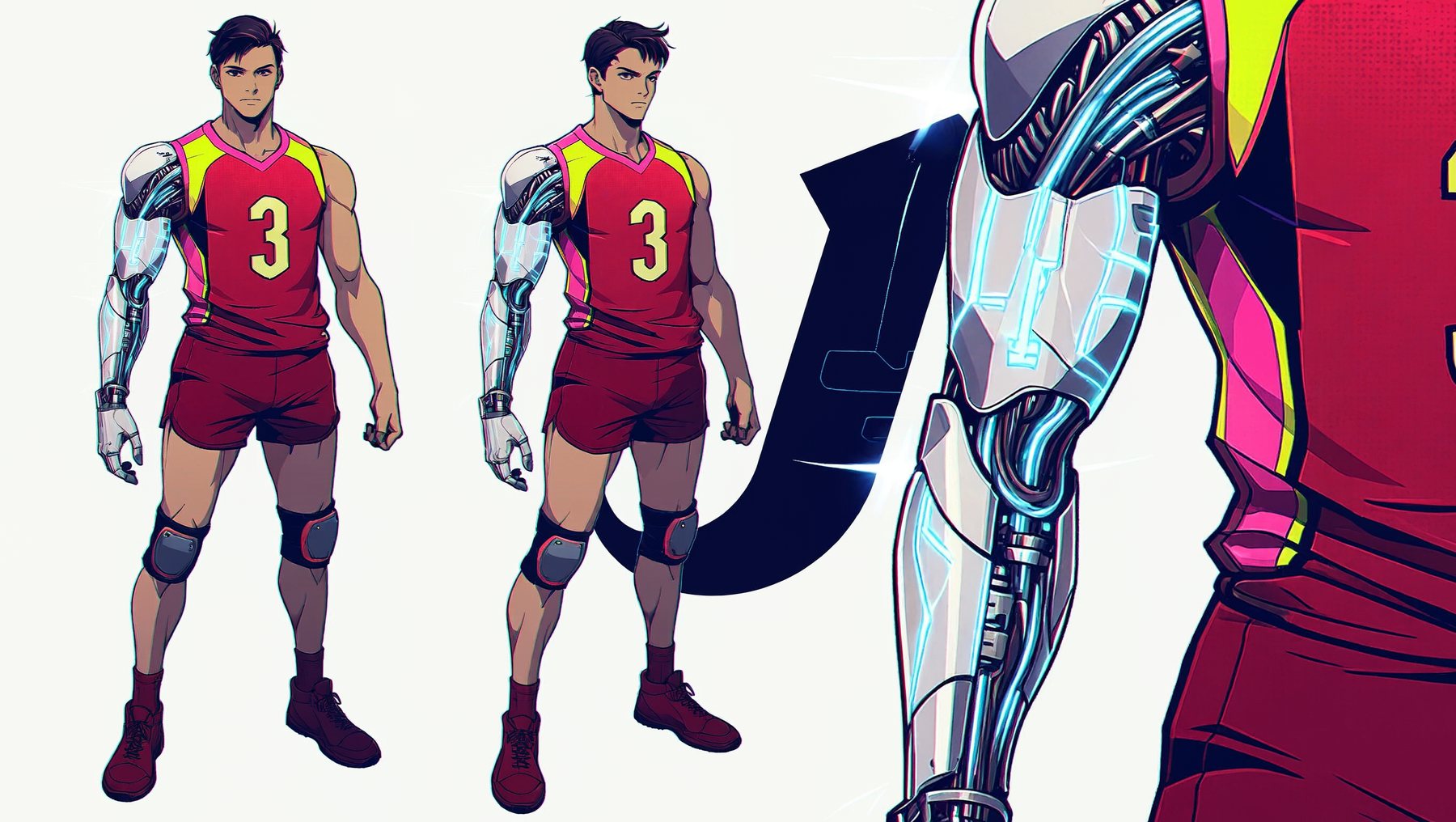
Kit Danjo#3
Medium build, a messy side part. A sleeve of optical fibre on the hitting arm, no implants.
Blindside. The charged Lob's landing point hides from the opponents' forecast until late.
The sleeve ripples like water before the touch.
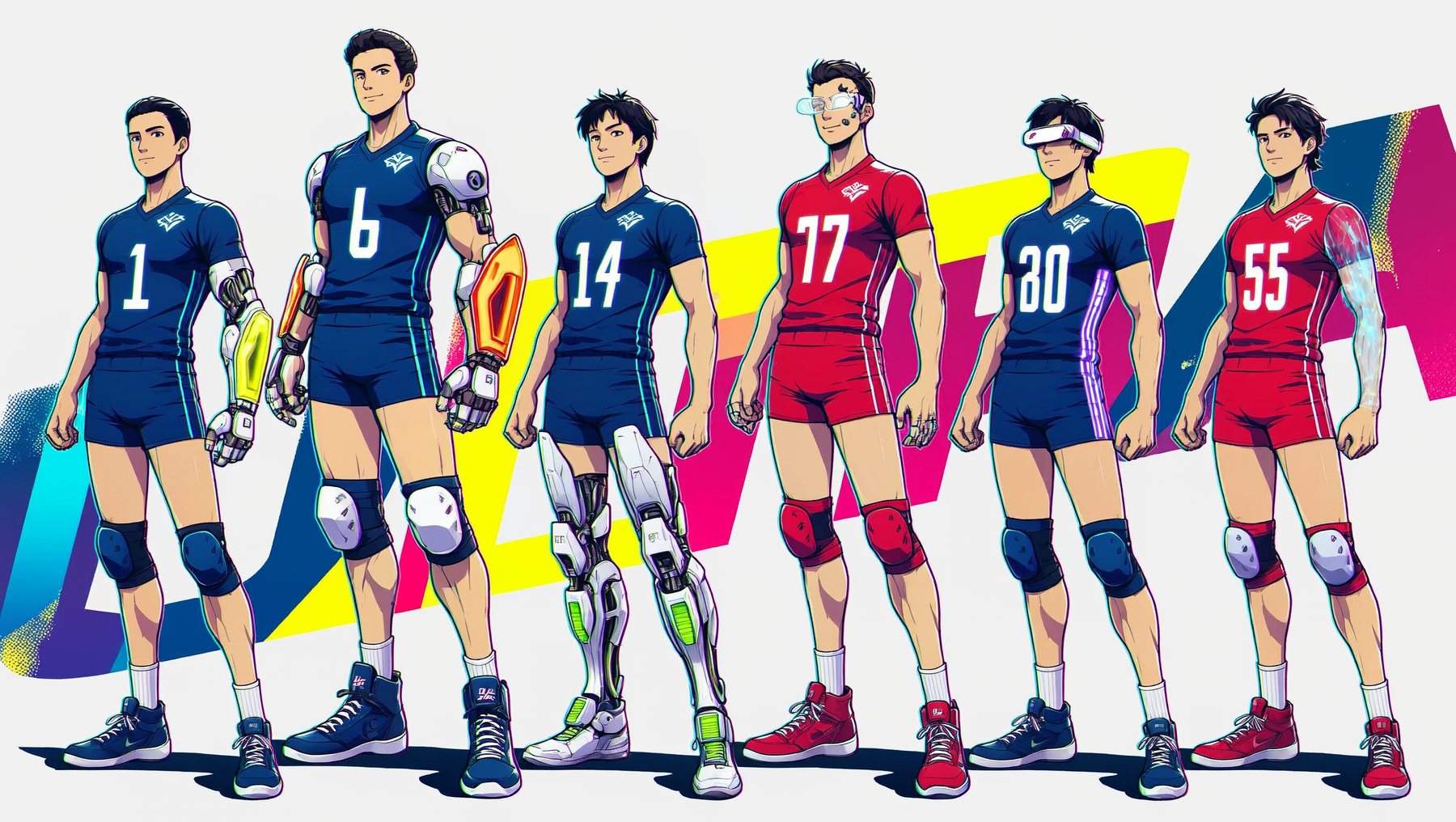
Concept sheets: MiniMax H3 Image (local), one per character; click an image for full size. Known faults of this round: the model draws most modifications as chrome, so the Bio origin (Kade, Pell, Sable) shows chrome in place of grown tissue and the Gear origin (Theo, Kit) shows cyber hands or arms in place of gloves and a fibre sleeve; Ivo is drawn as a woman. The class reads are right; the origins need a second round with stronger prompts or another model. Parked (owner, 29 November 2026: "no other decition will be made for now"): the roster mix (the game has only men's models today; the examples include women), the team size and the libero rule, how many classes a team may stack, and whether Bio grafts have a drawback in play (for example a stamina cost). The names are new and original; check each one for trademarks before use.
09The 3D characters: rules and estimates
Where we are and where we go. Our current best model is Way D (the owner's Ren model, refined): adult proportions, painted texture, MToon shading, a thin hair outline, 19,749 triangles, 7 materials, the fixed v2 skeleton.
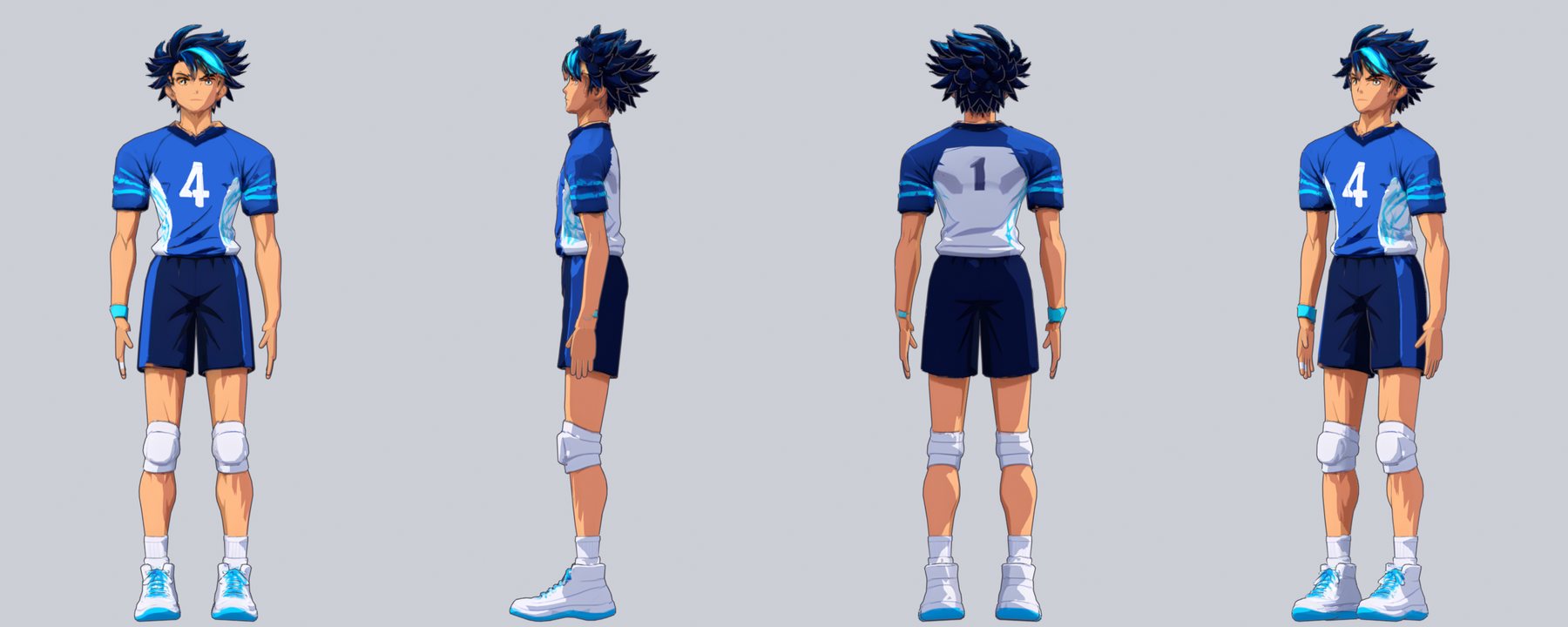
character01d), the baseline. No cyber parts yet.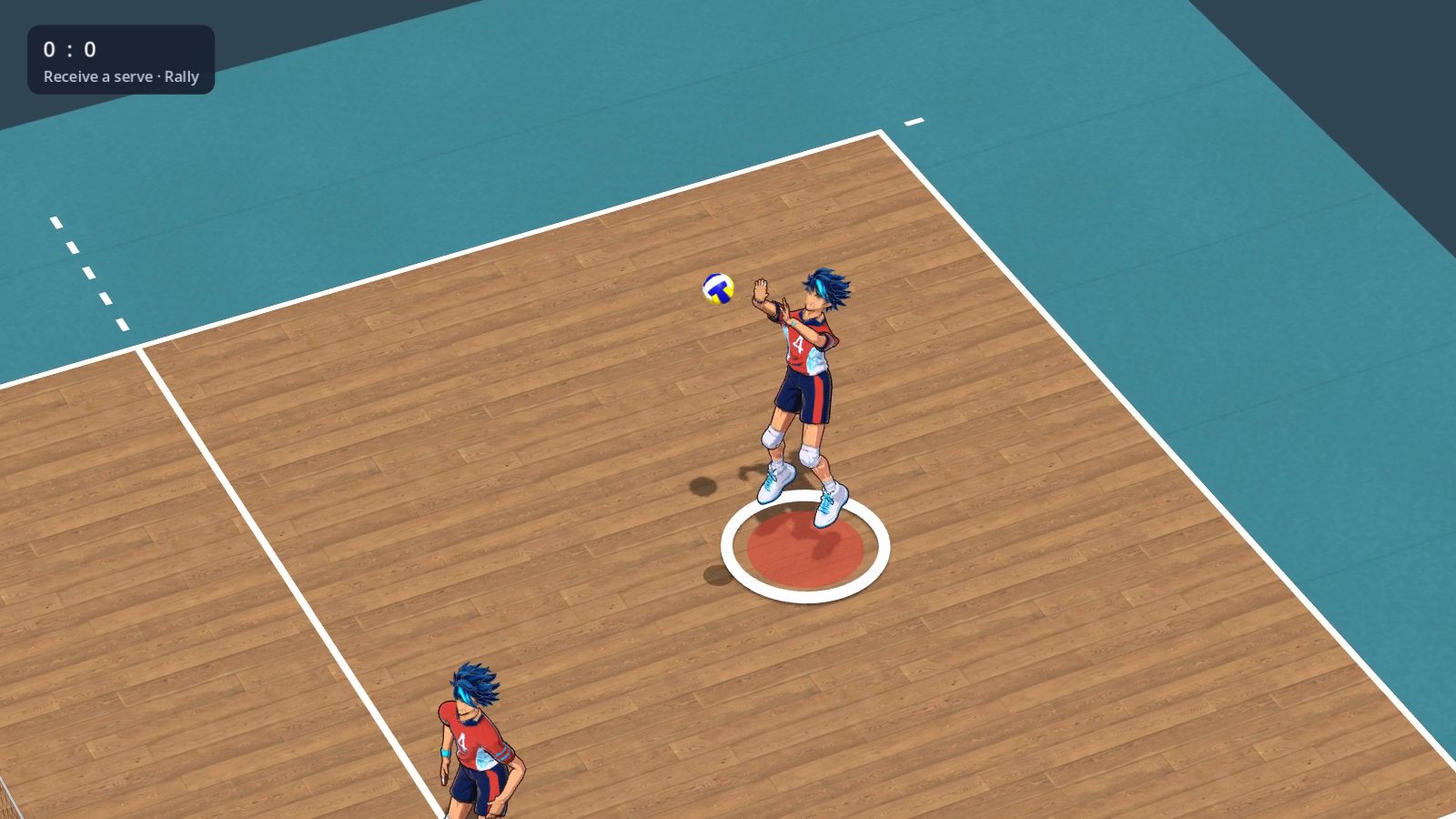
Ten rules for every character
| # | Rule | Status today |
|---|---|---|
| 1 | About 7 heads, adults 18 to 24; head a little larger than real, hands and feet 1.2 to 1.4 times; broad shoulders | Done (Way C and D). Shins 84 % of the source: v2 knee limit |
| 2 | Painted base colour with painted highlight and shadow shapes; shadows shifted toward violet | Partly: painted, shadows not yet violet |
| 3 | Toon shading in two steps, one hard edge; no specular except a small chrome highlight | MToon in place; settings to tune |
| 4 | Outline: inverted hull, ink #0B0B14 on the body, the hair's own colour on the hair; thicker on the silhouette | Done (hair rule 4); body ink to check |
| 5 | One team colour on a large jersey area, a large number, one trim colour | Done (team colour swap works) |
| 6 | Cyber parts: 2 to 4 per character, a hard seam at the skin, chrome with an ink base | New |
| 7 | Emissive in thin lines and small panels; bloom only in post effects and VFX | New (one emissive material) |
| 8 | Seams and panel lines painted or in simple geometry steps; chrome as a painted gradient (no normal maps: Godot #94500) | Rule already in force |
| 9 | At most 26,000 triangles and 8 materials | Done (19,749 and 7) |
| 10 | Check every design in greyscale at about 106 px | New check for the board tool |
Estimate: one cyber athlete (target)
| Part | Triangles | Share |
|---|---|---|
| Head and hair | 6,000 to 7,000 | |
| Body and kit | 6,000 to 7,000 | |
| Cyber part(s) | 3,000 to 5,000 | |
| Hands (Way A five fingers) | about 2,000 | |
| Shoes | about 2,000 | |
| Pads, bands, gadgets | 1,000 to 2,000 | |
| Total | 20,000 to 25,000 | budget 26,000 |
| Material (8 at most) | Texture |
|---|---|
| Skin | painted base colour, 2048 atlas shared with face |
| Face | painted eyes and brows (same atlas) |
| Hair | painted, hair outline in its own colour |
| Team cloth | greyscale value × team colour |
| Other cloth and shoes | painted |
| Chrome and ceramic | painted gradient, ink base |
| Emissive | 512 mask, ability colour, pulse driven by gameplay |
| Spare | one gadget or a special skin |
Pipeline and effort (estimates, to confirm on the first cyber athlete)
- Concept: turnaround from the image models in the chosen look; the owner picks; about half a day with reviews.
- 3D base: image to 3D or the owner's model, then the Way D build script (clean, reduce, fit to the fixed v2 skeleton, skin, roles); the script runs in about 75 s, the review takes hours.
- Cyber part: modelled in Blender (background, on copies) as a separate rigid piece on its bone, so it can swap per ability; one to two days for the first, less after a kit of parts exists.
- Look in Godot: MToon with violet shadow, ink outline, emissive pulse hooked to gameplay events; the board and a played match for acceptance.
- Risk: the fixed skeleton shortens some proportions (Way D shins 84 %); a cyber part that changes the silhouette of the arm must keep the hand contact points (the rules measure from the skeleton).
10Arena, effects and interface
Arena
A neon gym-stadium at night: a bright wood or polymer court (the court colour stays away from both team colours), a dark surround in shadow violet, LED boards and a holographic crowd, wet reflections only outside the court lines so the ball's shadow stays clear.Effects
Contact frame held with a hard-edged shock ring (Haikyu!!); a halftone and chromatic split only on the Perfect Spike and special moves; speed lines on the attack only; the ability glow pulses on the cyber part, never on the jersey. The parked "acceleration" feeling of the Perfect Spike fits here.Interface
Broadcast style: lower-thirds with a diagonal cut, a big Teko number, a stat plate with a thin cyan outline, magenta for warnings, volt for the primary action. Chakra Petch for labels.11Decisions for the owner (parked)
- Accept look A ("Neon Spike") as the direction, or wait for the Nano Banana look to compare.
- Team colours: keep blue and red, or move to cyan and magenta.
- Ren's signature part: the forearm only (as planned) or the whole arm (as in the MiniMax turnaround).
- How much cyber per athlete: 2 to 4 parts (recommended) or one big signature limb for a few rare characters (Akira style).
- The first cyber athlete to build after Ren: the blocker (hydraulic legs) or the setter (cyber eye and hands).